
The Fount of Inspiration : Smt. Manekba
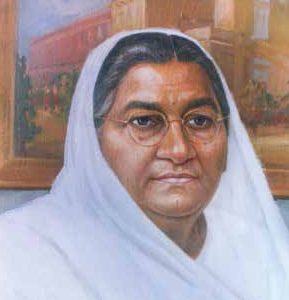
Smt. Manekba was born in the year 1887 in a pious Jain family. She was a very caring lady who looked after not only her own family, but also the family of Sarabhai and a large number of children of other Jain families who were invited to live in her house at Ahmedabad for their education.
After the sad demise of Chimanlal Sheth, Smt. Manekba took it upon herself to fulfill all his dreams including his dream of creating adequate facilities for children of poor families from rural areas. For this purpose Manekba acquired a considerably large plot of land in Ambawadi and created Sheth C. N. Vidyavihar. In her personal life she maintained simplicity to an extreme and created a model for the concept of trusteeship in the Gandhian ideology. After a long and fruitful lifetime Smt. Manekba passed away in 1953. At the time of her demise, she had expressed a desire to create similar educational facilities in rural areas also, especially for the farmers and women of rural areas.
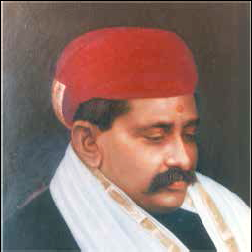
Sheth Shree Chimanlal Nagindas
Shree Chimanlal was born in 1867 in Ahmedabad, in an elite Gujarati family of Shree Nagindas (father) and Smt. Chanchalben (mother). He had an elder brother named Sarabhai. Their maternal grandfather Sheth Maganbhai Karamchand was a very wealthy businessman. Since Sheth Maganbhai had no heir, he accepted Sarabhai as an adopted son. Thus Chimanlal continued as a member of a middle class family, whereas his elder brother Sarabhai became a millionaire.
Chimanlal was a brilliant student and in addition to his wide reading, he earned a name as a bright student of mathematics. The family had developed a rich home-library and used to receive about 35 magazines. Unfortunately, Sarabhai died at a young age in 1895 leaving the responsibility of raising his children and managing the vast property on the shoulders of Sheth Chimanlal, who looked after Sarabhai’s children Ambalalbhai, Ansuyaben and Nirmalaben and made provision for their education as well as carried out all social responsibilitiees. After the demise of Sarabhai, Chimanlal was elected the president of Dasha Shimali caste. He made provision for the educati on of all the children of his community and became one of the leaders of Shree Anandji Kalyanji ni Pedhi. In these activities he worked in co operation with Shree Lalbhai and together they created facilities for the education and development of the whole community.
Above all, he lived a noble life and in addiction to earning a lot of wealth, he donated generously to the activities taken up by national, religious and social bodies at that time. Among these donations noteworthy are his contributions to educational institutions. At the time of his demise he left behind his wife Pujya Manekba and three daughters, Nirmalaben, Vasuben and Induben.
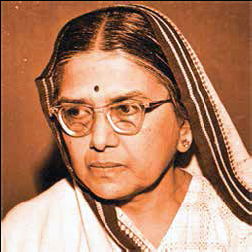
Padmashri Indumatiben Sheth
(1906 – 1985)
Indumatiben had lost her father at the tender age of two years. This gave her an opportunity to observe the life of Smt. Manekba who led a pious and socially productive life after the demise of her husband Seth Chimanlal. Indumatiben was very close to Smt. Manekba and even while she was a student at the Gujarat Vidyapeeth, she started taking active interest in the management of Sheth C. N. Vidyavihar.
Although she was not keen on holding public office, she got opportunities to offer her services as the deputy minister for education in undivided Bombay Presidency and as the first education minister in the Government of Gujarat. Apart from this important contribution, Indumatiben carried out various constructive activities as advised by Mahatma Gandhi including those of Gramodhyog, laborer’s association and women’s empowerment movement. To concretize her work in these areas she helped establish intuitions like Khadi Mandir and Mahila Samunnati Sangh.
In addition to the development of Sheth C. N. Vidyavihar as an urban education centre, she decided to create a similar institution to facilitate education in rural areas. This led to the development of Smt. Manekba Vinayvihar at Adalaj. It is noteworthy that Vinayvihar was created primarily for women’s education. At the same time she created facilities for education and research leading to progressive farming, experimental agriculture and Gou-shala with all the modern facilities which were not available in rural areas at that tme.
The outstanding characteristic of Indumatiben’s life was her simplicity, which was noticeable not only in her Khadi dress but also in her insistence to adopt the simplest possible food and lifestyle that impressed everyone that came into her contact. She was a member of the senate and syndicate of newly established Gujarat University. She was a member of UGC also. Thus she contributed at the local level and also at the state and national level during her lifetime.